
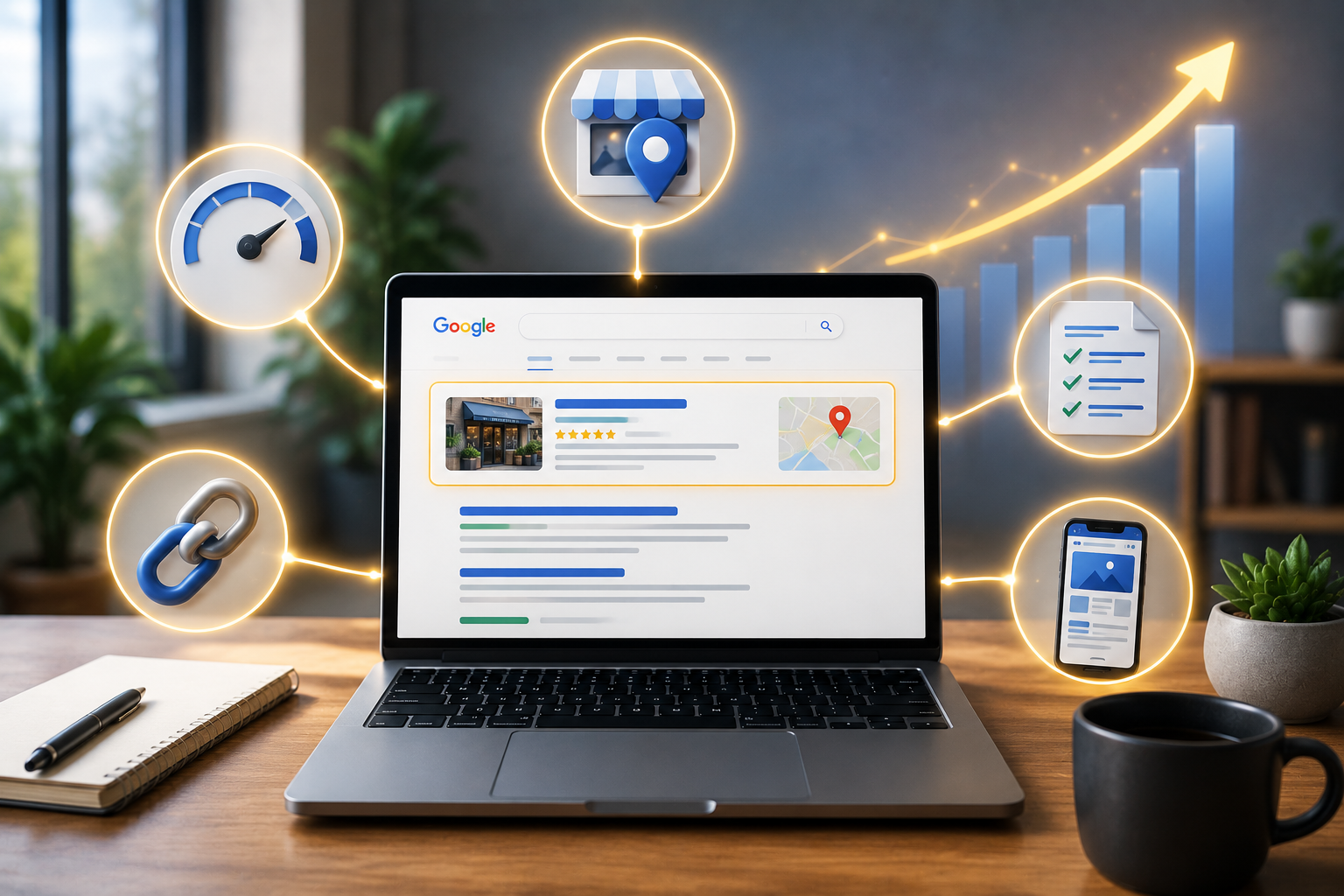
If your business isn't showing up on Google as often as you'd like, you're not alone.
Many small business owners assume ranking higher requires hiring an expensive marketing agency, publishing content every day, or learning complicated technical strategies.
The truth is that some of the most meaningful improvements come from consistently doing the fundamentals well.
Whether you're a contractor in Oviedo, a chiropractor in Winter Springs, a coffee shop in Orlando, or a family-owned business anywhere in Central Florida, these five actions can strengthen your online visibility starting today.
TL;DR
- Complete and improve your Google Business Profile.
- Rewrite unclear page titles and meta descriptions.
- Ask satisfied customers for genuine Google reviews.
- Improve your website's mobile speed and usability.
- Publish one helpful answer to a real customer question.
- Keep your business information consistent across the web.
- Do not expect overnight rankings, but do expect consistent improvements to compound over time.
Can You Really Improve Your Google Rankings Today?
You probably will not jump from page five to the first position in a single afternoon.
However, you can make changes today that improve how clearly Google understands your business, how confidently customers evaluate it, and how effectively your website converts visitors into leads.
Think of SEO like maintaining a storefront.
Cleaning the windows once will not create a successful business, but a clean, organized, trustworthy storefront makes it easier for customers to walk inside.
Your website and business listings work the same way.
1. Complete Your Google Business Profile
Your Google Business Profile is often one of the first things potential customers see when they search for your company or a service nearby.
It may appear in Google Maps, local search results, branded searches, and mobile recommendations before someone ever visits your website.
An incomplete or outdated profile creates uncertainty. A complete profile helps customers understand what you offer, where you operate, when you are available, and how to contact you.
Review These Details Today
- Official business name
- Primary business category
- Relevant secondary categories
- Current phone number
- Correct website address
- Business hours
- Holiday or special hours
- Physical address or service area
- Business description
- Products or services
- Appointment or estimate links
- Logo
- Cover photograph
- Recent photographs of your business or work
Choose Your Categories Carefully
Your primary category should describe the main service or business type customers hire you for.
Do not choose unrelated categories simply because you want to appear for more searches. Accuracy helps Google understand when your business is relevant.
Add Real Photographs
Use photographs of your team, storefront, vehicles, products, completed projects, office, or customer experience.
Real photographs help customers recognize your business and generally create more trust than generic stock images.
Check Your Website Link
Make sure your profile links to the most useful page on your website.
Most businesses should link to the homepage. A location with its own dedicated page may benefit from linking directly to that location page.
If you have never reviewed your profile, set aside 20 to 30 minutes today. It is one of the most valuable free marketing assets available to a local business.
2. Improve Your Page Titles and Meta Descriptions
Every important page on your website should clearly tell both visitors and search engines what the page is about.
A surprising number of small business websites still use titles such as:
- Home
- Welcome
- Services
- Untitled Document
- Company Name
These titles provide very little context.
A Better Homepage Title
Weak:
Home
Stronger:
Roof Replacement in Oviedo, FL | ABC Roofing
A useful title usually includes:
- The page's primary topic or service
- The relevant location when appropriate
- The business name
Use a Unique Title for Every Page
Do not give every page the same title.
If your company offers several services, each page should describe its own topic.
Example Service Page Titles
- Roof Repair in Oviedo, FL | ABC Roofing
- Metal Roofing Installation in Central Florida | ABC Roofing
- Emergency Roof Leak Repair | ABC Roofing
- Commercial Roofing Services | ABC Roofing
Do Not Forget the Meta Description
A meta description is the short summary that may appear beneath your page title in search results.
It does not guarantee a higher ranking, but a clear description can help searchers understand why they should visit your page.
Weak:
Welcome to our website. Learn more about our services.
Stronger:
Professional roof replacement and repair serving Oviedo and surrounding Central Florida communities. Request a free estimate from ABC Roofing.
Quick Page Title Checklist
- Is the title unique?
- Does it clearly describe the page?
- Does it include the service customers actually search for?
- Does it mention the location naturally when relevant?
- Does it include the business name?
- Would a customer understand it immediately?
3. Ask Satisfied Customers for Google Reviews
Reviews influence how potential customers evaluate your business.
When comparing several local companies, people often look at:
- Overall rating
- Number of reviews
- How recent the reviews are
- What customers specifically mention
- How the business responds
Recent, genuine reviews can strengthen trust and support local search visibility.
When Should You Ask for a Review?
- Immediately after completing a successful job
- After resolving a customer's problem
- Following positive feedback
- When a customer compliments your team
- After a repeat customer makes another purchase
- After a successful appointment or consultation
Do not wait several weeks. Customers are more likely to respond while the positive experience is still fresh.
Make the Process Easy
Create a direct Google review link that takes customers to the correct review form.
You can share the link through:
- Text message
- Printed receipt
- Thank-you card
- QR code
- Follow-up message
Simple Review Request Example
Thank you for choosing us. If you were happy with your experience, would you mind sharing an honest Google review? Your feedback helps other local customers find and trust our business.
Encourage Honest Detail
Do not tell customers exactly what to write.
You may invite them to describe the service they received, the community they are located in, and what stood out about the experience.
A detailed review gives future customers more useful information than a short review that only says, "Great company."
Respond to Your Reviews
Thank customers for positive feedback and respond professionally to criticism.
Your response is not only for the reviewer. Future customers will also see how you communicate when something goes wrong.
4. Improve Your Website Speed and Mobile Experience
People are impatient online.
If a page loads slowly, shifts around while loading, or is difficult to use on a phone, visitors may leave before they understand what your business offers.
Website performance affects both the customer experience and your ability to turn traffic into leads.
Quick Improvements You Can Make
- Compress oversized images.
- Resize images before uploading them.
- Use modern image formats when practical.
- Remove scripts, widgets, or plugins you no longer use.
- Avoid automatically loading large homepage videos.
- Reduce unnecessary animation.
- Use quality website hosting.
- Test your contact forms on a phone.
- Make buttons large enough to tap.
- Make your phone number clickable.
Do Not Chase a Perfect Score
You do not need a perfect website-performance score to serve customers well.
The more important question is whether your website feels fast, stable, and easy to use on the devices your customers actually use.
Test More Than the Homepage
Your homepage may load quickly while your service pages, gallery, blog posts, or contact page remain slow.
Test the pages that receive traffic and generate leads.
Check the Mobile Conversion Path
Open your website on a phone and attempt to complete the same steps a customer would.
- Can you understand the service immediately?
- Can you find the phone number?
- Can you request an estimate?
- Can you complete the contact form?
- Can you read the text without zooming?
- Can you navigate without frustration?
A faster website is valuable, but a fast website that is confusing will still lose customers.
5. Answer One Real Customer Question
This is one of the most overlooked SEO opportunities available to small businesses.
You already know what your customers want to understand because you answer many of the same questions every week.
Turn one of those answers into a useful website article.
Questions a Roofer Might Answer
- How long does a roof replacement take?
- How do I know whether I need repair or replacement?
- Does homeowners insurance cover storm damage?
- Which roofing material works best in Florida?
Questions a Chiropractor Might Answer
- What should I expect during my first appointment?
- How long does a typical visit take?
- When should I speak with a medical doctor first?
- What services does the practice provide?
Questions a Restaurant Might Answer
- Do you offer gluten-free options?
- Can you accommodate food allergies?
- Do you accept reservations?
- Can customers reserve a private room?
Questions a Contractor Might Answer
- How much does the service typically cost?
- How long will the project take?
- Do I need a permit?
- What should I do before the crew arrives?
A helpful article creates another page that search engines can understand and potential customers can discover.
It also builds trust before someone ever calls.
How to Structure the Article
- State the question clearly.
- Give a direct answer near the beginning.
- Explain what affects the answer.
- Use examples from real experience.
- Address common misconceptions.
- Explain the customer's next step.
- Link to the relevant service page.
Write for the customer first. Do not stretch a simple answer into a long article just to reach a particular word count.
Bonus Action: Keep Your Business Information Consistent
Search engines and customers should find the same core business information wherever your company appears online.
Review your:
- Business name
- Address
- Phone number
- Website URL
- Business hours
- Primary category
- Service area
Check that information across:
- Your website
- Google Business Profile
- Bing Places
- Apple Business Connect
- Yelp
- Nextdoor
- Chamber directories
- Industry directories
Minor formatting differences are not necessarily a crisis, but incorrect phone numbers, old addresses, expired websites, and conflicting hours can create real customer problems.
Read Build Domain Authority with Business Directories for a deeper look at creating and maintaining business listings.
Bonus Action: Add Internal Links
Internal links connect one page of your website to another.
They help visitors find related information and help search engines understand the structure of your website.
Examples
- Link a roofing article to your roof-repair service page.
- Link your homepage to your most important services.
- Link a city page to relevant project examples.
- Link an FAQ to a detailed guide.
- Link related educational articles together.
Use descriptive anchor text instead of vague phrases such as "click here."
For example:
Learn what SEO is and why it matters for local businesses.
What You Should Avoid
Buying Fake Reviews
Fake reviews violate platform policies, mislead customers, and can damage your reputation.
Keyword Stuffing
Repeating phrases such as "Orlando plumber" throughout every paragraph creates an awkward customer experience and does not make a weak page helpful.
Changing Your Business Name to Add Keywords
Your Google Business Profile should use your real-world business name. Adding unnecessary services or locations to the name can create policy problems.
Creating Fake Locations
Do not create addresses, offices, or location pages for places where your business has no legitimate presence or service connection.
Publishing Thin AI Content
AI can help with research, outlines, and editing, but generic articles without real experience or careful review rarely distinguish your business.
Ignoring Mobile Visitors
Many local customers will visit your website from a phone. If they cannot call, navigate, read, or submit a form easily, you may lose the lead.
Expecting Overnight Results
SEO is cumulative. Small improvements made consistently tend to outperform occasional bursts of activity followed by months of neglect.
A 60-Minute SEO Action Plan
You can make meaningful progress today without spending the entire day on marketing.
First 15 Minutes
- Review your Google Business Profile.
- Correct your hours, phone number, website, and category.
Next 10 Minutes
- Check your homepage title.
- Rewrite it so it clearly describes your main service and location.
Next 10 Minutes
- Send a review request to two or three recent satisfied customers.
Next 10 Minutes
- Open your website on your phone.
- Test the navigation, phone number, and contact form.
Final 15 Minutes
- Write down five questions customers regularly ask.
- Choose one question for your next article or FAQ.
Create a Monthly SEO Habit
You do not need to spend hours every day working on SEO.
Commit to completing one meaningful improvement each month.
- Publish one helpful article.
- Add recent project photos.
- Request five genuine reviews.
- Improve one service page.
- Check for broken links.
- Update one page title and meta description.
- Review your Google Business Profile.
- Add internal links to older content.
- Update outdated business information.
- Create one new case study.
After a year, your website and online presence can be substantially stronger than they are today.
How These Actions Work Together
Each of these steps supports a different part of your online presence.
| Action | Primary Benefit |
|---|---|
| Improve Google Business Profile | Local visibility and customer confidence |
| Rewrite page titles | Clearer page relevance |
| Request genuine reviews | Trust and local reputation |
| Improve mobile performance | Better user experience and conversions |
| Answer customer questions | More useful content and search opportunities |
| Maintain consistent listings | Accurate local business information |
Helpful Resources for Central Florida Entrepreneurs
- What Is SEO and Why Should You Care?
- How to Get Free Backlinks That Actually Help Your SEO
- Build Domain Authority with Business Directories
- 7 Ways to Turn Your Website Into a Passive Lead Generator
- What Marketing Should Your Business Actually Be Doing?
- How to Get AI to Recommend Your Business
- SCORE Orlando offers mentoring and educational resources for business owners.
- Orlando Economic Partnership supports businesses throughout the Orlando region.
- Seminole County Chamber provides networking and local business-development opportunities.
- U.S. Small Business Administration provides planning, funding, and management resources.
Need Help Improving Your Rankings?
You do not have to figure everything out on your own.
At BastionTech, we help contractors and local service businesses improve their online presence through custom websites, technical SEO, local SEO, Google Business Profile optimization, and website-performance improvements.
Whether you are launching a new business or improving an existing website, the focus is on practical improvements that support qualified leads rather than vanity metrics.
Helpful BastionTech Services
- Local Contractor SEO in Central Florida
- Google Business Profile Optimization
- Oviedo Web Design
- Website Project Scope and Pricing
- Request a Free Website Review
Frequently Asked Questions
Can I Improve My Google Ranking in One Day?
You can make useful improvements in one day, but rankings generally take time to respond. Today's work strengthens the foundation that supports future visibility.
Should I Focus on My Website or Google Business Profile First?
Local businesses should usually maintain both. If your Google Business Profile is incomplete or inaccurate, correcting it may be the fastest place to begin. Your website provides the deeper information customers need before contacting you.
How Often Should I Publish New Content?
There is no required publishing frequency. Quality matters more than volume. One useful article based on a real customer question is more valuable than several rushed or repetitive posts.
Do Google Reviews Affect SEO?
Reviews contribute to your local reputation and can influence customer decisions. Review quantity, quality, recency, and responsiveness may all support your broader local presence.
Do I Need a Perfect Website-Speed Score?
No. Focus on providing a fast, stable, and usable experience. Scores can identify opportunities, but the customer's real experience matters most.
Should Every Page Include My City?
No. Mention your location where it is relevant and helpful. Forcing the same city name into every heading and paragraph can make the content unnatural.
Can I Use AI to Write My Business Content?
AI can help organize ideas and improve drafts, but your published content should include accurate facts, real experience, original examples, and careful human review.
How Do I Know Whether SEO Is Working?
Track search impressions, website visits, phone calls, contact forms, estimate requests, appointments, and sales. Ask new customers how they found you rather than relying only on rankings.
Continue Growing Your Business
Use these free guides to strengthen your website, local visibility, authority, and overall marketing strategy.
- What Is SEO and Why Should You Care?
- How to Get Free Backlinks That Actually Help Your SEO
- Build Domain Authority with Business Directories
- 7 Ways to Turn Your Website Into a Passive Lead Generator
- What Marketing Should Your Business Actually Be Doing?
- How to Get AI to Recommend Your Business
Discover Central Florida Business Stories
Local Legends Orlando shares the stories behind entrepreneurs, organizations, and family-owned businesses serving communities throughout Central Florida.
- BastionTech LLC: A Local Legends Story
- Zeigers Auto Detailing: A Local Legends Story
- Redefining With Jesus: A Local Legends Story
Final Thoughts
You do not need to become an SEO expert overnight.
Start with the fundamentals, make one meaningful improvement at a time, and stay consistent.
Complete your Google Business Profile. Clarify your page titles. Request genuine reviews. Improve the mobile experience. Answer customer questions.
Each change makes it a little easier for tomorrow's customers to discover, understand, and trust your business.