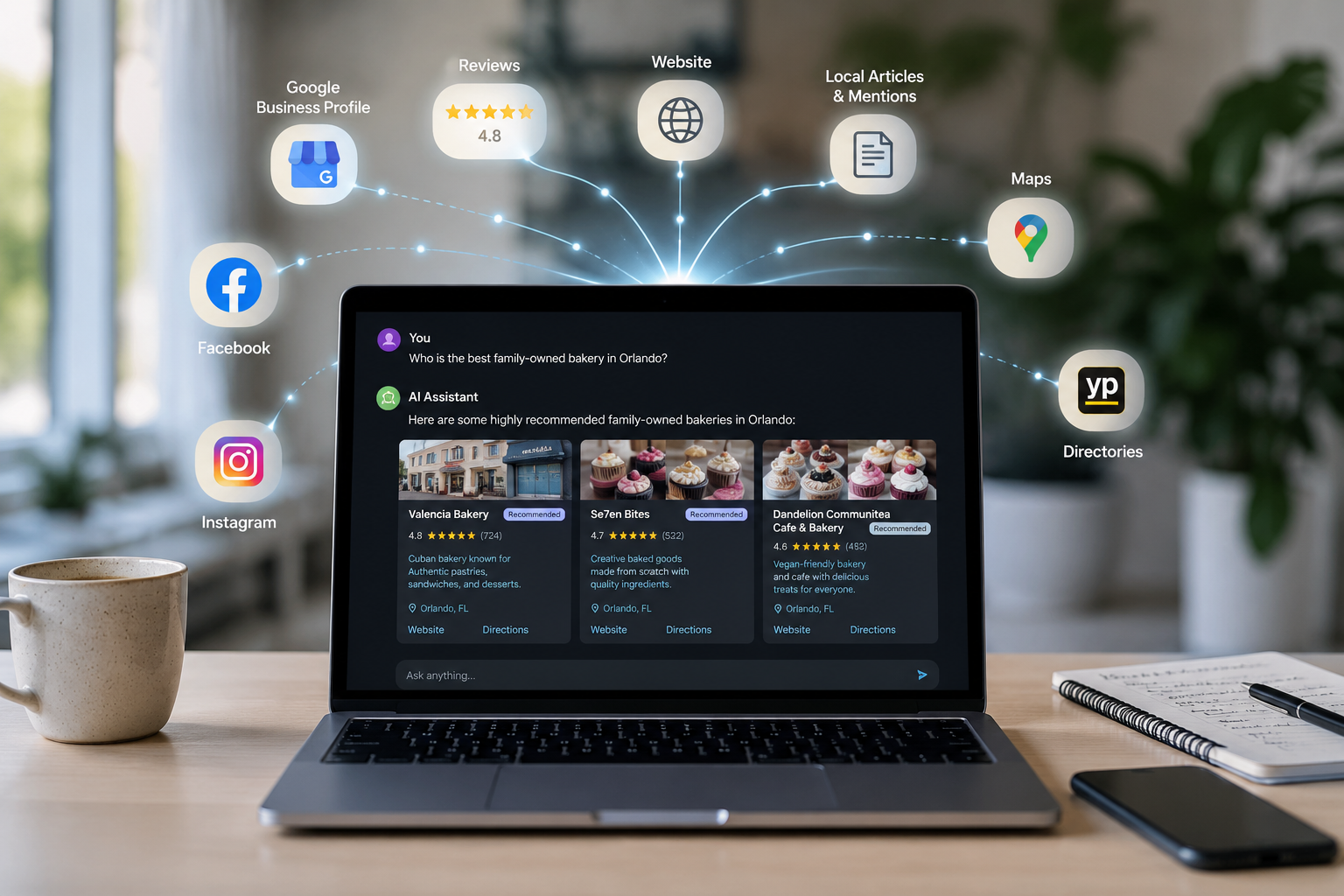
People are no longer using only traditional Google searches to find businesses.
They are also asking questions such as:
- Who is the best roofer near Oviedo?
- What are some family-owned restaurants in Central Florida?
- Can you recommend a local web designer for contractors?
- Which Orlando businesses offer gluten-free options?
- Where can I find a trustworthy auto detailer nearby?
These questions may be asked through ChatGPT, Google's AI search features, Microsoft Copilot, Perplexity, Gemini, voice assistants, or other discovery tools that emerge in the future.
That creates an important question for business owners:
How do you help AI systems understand, trust, and potentially recommend your business?
There is no button, file, or marketing trick that guarantees an AI recommendation.
However, there are practical steps you can take to make your business easier for search engines and AI systems to discover, understand, verify, and cite.
TL;DR
- AI visibility begins with strong traditional SEO.
- Clearly explain who you are, what you offer, who you serve, and where you operate.
- Keep business information consistent across your website, Google Business Profile, directories, and social profiles.
- Publish specific, original content based on genuine experience.
- Earn trustworthy reviews, mentions, citations, and backlinks.
- Make your website crawlable, indexable, fast, and technically understandable.
- Use structured data where appropriate, but do not expect schema markup alone to generate recommendations.
- Build independent sources that confirm your business exists and is active in its community.
- Do not rely on mass-produced AI articles, fake mentions, or unproven optimization shortcuts.
What Is Generative Engine Optimization?
Generative Engine Optimization, often shortened to GEO, refers to improving the likelihood that a business, brand, website, or source will appear in AI-generated answers and recommendations.
You may also hear terms such as:
- Answer Engine Optimization
- AI Search Optimization
- Large Language Model Optimization
- LLM Optimization
- AI Visibility
The terminology is still developing, but the basic goal is straightforward.
You want AI-powered systems to:
- Discover information about your business.
- Understand what your business offers.
- Identify where and whom you serve.
- Verify that the information is consistent.
- Recognize evidence that your business is trustworthy.
- Consider your business relevant when answering a customer's question.
GEO is not a replacement for SEO.
In most cases, it builds on the same foundation: useful content, clear business information, technical accessibility, authority, third-party confirmation, and a strong reputation.
How Do AI Tools Find Businesses?
Different AI products use different technologies, indexes, search partners, browsing tools, databases, and sources.
Depending on the platform and question, an AI-generated answer may be influenced by:
- Search-engine results
- Publicly accessible websites
- Google Business Profiles
- Bing Places listings
- Business directories
- Local publications
- News coverage
- Review platforms
- Social profiles
- Industry associations
- Professional directories
- Previously published web content
- Current web searches performed while answering a question
This means your business needs more than a single homepage and a social-media profile.
AI systems are more likely to understand your company when multiple trustworthy sources consistently describe who you are, what you do, where you operate, and why people choose you.
1. Clearly Explain Your Business
Your website should make the fundamentals immediately clear.
- What is the name of your business?
- What products or services do you provide?
- Who do you serve?
- Where are you located?
- Which communities do you serve?
- What makes your approach different?
- How can someone contact you?
A vague homepage makes your business difficult for customers, search engines, and AI systems to understand.
For example, a heading such as:
Creating Better Experiences for Tomorrow
may sound polished, but it does not explain what the company actually does.
A clearer heading might be:
Custom Website Development and Local SEO for Central Florida Businesses
The second version communicates the service, audience, and region immediately.
Use Clear Supporting Language
Your homepage should reinforce the primary heading with a short explanation of:
- Your main services
- Your ideal customer
- Your primary service area
- The problem you help solve
- The next step visitors should take
Clarity is more useful than a clever slogan that could describe almost any company.
2. Create a Page for Every Important Service
Do not force customers, search engines, or AI tools to guess what you offer.
If a contractor offers roof replacement, roof repair, metal roofing, gutter installation, and storm-damage inspections, each important service should have its own useful page.
Individual service pages allow you to explain:
- What the service includes
- Who needs it
- Which problems it solves
- What customers should expect
- How the process works
- What affects cost
- Where the service is available
- Frequently asked questions
- Examples of completed work
A clearly focused service page gives retrieval systems more useful information when someone asks a detailed question.
Connect Services to Supporting Content
Each service page should link to relevant:
- Case studies
- Project galleries
- Frequently asked questions
- Customer reviews
- Location pages
- Educational articles
- Contact or estimate forms
This creates a connected information structure rather than a collection of isolated pages.
3. Strengthen Your Local Business Information
Local recommendations depend heavily on geographic relevance.
Your website should clearly identify your legitimate location or service area.
Your business name, address, phone number, website, hours, and categories should remain consistent across major platforms.
Important Listings to Review
- Google Business Profile
- Bing Places for Business
- Apple Business Connect
- Yelp
- Nextdoor
- Local chamber directories
- Industry-specific directories
- Supplier and manufacturer directories
Do not create fake offices, virtual locations that violate platform rules, or location pages for cities you do not genuinely serve.
Accurate local information is more valuable than a large collection of misleading location claims.
4. Complete Your Google Business Profile
Your Google Business Profile is one of the most important public sources of structured information about a local business.
Make sure your profile includes:
- Correct business name
- Accurate primary category
- Relevant secondary categories
- Current phone number
- Correct website address
- Updated business hours
- Holiday hours
- Products or services
- Business description
- Real photographs
- Service areas when applicable
- Appointment or estimate links when appropriate
A complete profile helps Google understand your business across traditional search, Maps, local results, and its evolving AI experiences.
Keep It Current
Review the profile whenever your:
- Hours change
- Phone number changes
- Website changes
- Service area expands
- Services change
- Business moves
Outdated information can weaken trust and create a poor customer experience.
5. Claim and Optimize Bing Places
Bing should not be ignored simply because Google has a larger traditional search audience.
Microsoft's search infrastructure supports Bing search and multiple AI-assisted discovery experiences.
Claiming your Bing Places listing gives Microsoft another accurate source for your business information.
You should also register your website with Bing Webmaster Tools so you can monitor:
- Indexing
- Crawl issues
- Search performance
- Sitemaps
- Backlinks
- Available AI citation reporting
6. Allow Appropriate Search Crawlers
A website cannot appear in current web-based results if the relevant search system cannot access it.
Review your robots.txt file, firewall, hosting configuration, and security tools to make sure you are not unintentionally blocking legitimate search crawlers.
OpenAI identifies OAI-SearchBot as the crawler used to surface websites in ChatGPT search.
This crawler is separate from GPTBot, which OpenAI associates with potential model training.
A website owner can make different access decisions for each crawler.
Official crawler information is available through the OpenAI crawler documentation.
Example robots.txt Direction
User-agent: OAI-SearchBot
Allow: /

User-agent: Googlebot
Allow: /

User-agent: Bingbot
Allow: /
Do not paste new rules into your robots.txt file without first reviewing the existing configuration.
A misplaced rule can unintentionally block important sections of your website.
7. Publish Original, Experience-Based Content
AI systems already have access to enormous amounts of generic information.
Another article that repeats the same basic advice found on thousands of websites may add very little value.
Your strongest opportunity is publishing information that comes from genuine experience.
Examples of Original Business Content
- Before-and-after project breakdowns
- Local pricing considerations
- Common mistakes you see customers make
- Answers to questions customers regularly ask
- Case studies
- Original photographs
- Local market observations
- Founder interviews
- Team-member interviews
- Lessons learned from real projects
- Comparisons based on professional experience
A roofer can explain how Central Florida storms affect different roofing materials.
An auto detailer can show how Florida sun, heat, rain, and road conditions affect vehicle paint.
A local restaurant can explain how it accommodates gluten-free diners.
A web developer can explain why a custom-built site may suit a contractor better than a template-based platform.
This type of firsthand information is more distinctive, useful, and reference-worthy than generic marketing copy.
8. Answer Specific Customer Questions
People often use AI tools for conversational, detailed questions rather than short keyword searches.
Instead of asking only:
Orlando web designer
someone may ask:
Who is a good Central Florida web developer for a small contractor who does not want to use WordPress?
Your website should contain enough specific information to demonstrate whether you fit that request.
Useful Questions to Answer
- Who is your service best for?
- Who might not be a good fit?
- How much does the service typically cost?
- What affects the final price?
- How long does the process take?
- Which geographic areas do you serve?
- What makes your approach different?
- What problems do you specialize in solving?
- What should customers prepare before contacting you?
- What happens after someone submits an inquiry?
Clear answers help both customers and retrieval systems determine whether your business is relevant.
9. Build Third-Party Confirmation
Your own website will naturally say positive things about your business.
Independent sources provide additional confirmation.
Helpful Third-Party Signals
- Customer reviews
- Local news articles
- Business interviews
- Community publications
- Chamber memberships
- Industry certifications
- Supplier directories
- Manufacturer directories
- Professional association listings
- Community sponsorships
- Backlinks from relevant websites
These sources help establish that your business is a real organization with a genuine reputation beyond its own website.
Read How to Get Free Backlinks That Actually Help Your SEO for practical ways to earn legitimate third-party references.
You can also review Build Domain Authority with Business Directories for additional listing opportunities.
10. Get Featured by Legitimate Local Publications
A detailed business profile or founder interview can create an independent source that explains who you are, how your business began, and why your work matters.
A strong feature can include:
- Your founder story
- Business history
- Services
- Photographs
- Community involvement
- Achievements
- Professional experience
- A contextual link to your website
Local Legends Orlando
Local Legends Orlando was created to become a trusted discovery hub for entrepreneurs, organizations, ministries, creators, and family-owned businesses throughout Central Florida.
Rather than publishing a blank company directory, Local Legends tells the stories behind local businesses.
Approved features may provide another accurate online source where customers and discovery systems can learn about:
- The people behind the company
- How the business began
- What it offers
- Which communities it serves
- What makes it distinctive
- Why customers trust it
The goal is not to manufacture backlinks.
The goal is to create useful editorial content that helps Central Florida consumers discover legitimate local businesses. A contextual backlink is valuable because it appears within a meaningful story about the business.
Submit your Central Florida business for consideration.
OrlandoVoyager
OrlandoVoyager also publishes founder interviews and business stories from throughout the Orlando area.
Business owners with a meaningful story, unusual journey, community impact, or useful professional perspective may consider submitting themselves or being nominated for a feature.
11. Earn Detailed Customer Reviews
Reviews are especially important for local businesses because they provide firsthand descriptions of real customer experiences.
A review that simply says “Great job” is positive, but a detailed review provides more useful context.
For example:
They replaced the windows in our Oviedo home, explained the available options, arrived on schedule, and kept the work area clean.
This review naturally identifies:
- The service performed
- The location
- The customer experience
- Specific reasons the company was trusted
Never tell customers exactly what wording to use, offer incentives for positive reviews, or create fake reviews.
Instead, ask customers to honestly describe the service they received and what stood out about their experience.
12. Establish Clear Authorship and Expertise
Readers should be able to tell who created your content and why that person is qualified to discuss the subject.
Articles should include an author name when appropriate, and your website should contain accurate information about the people behind the business.
Helpful Author and Business Details
- Full name
- Professional role
- Relevant experience
- Credentials or certifications
- Areas of specialization
- Professional photograph
- Links to appropriate professional profiles
Do not invent credentials or inflate experience.
Clear, verifiable expertise is more valuable than exaggerated authority claims.
13. Use Structured Data Appropriately
Structured data is machine-readable code that helps search engines understand specific information on a webpage.
Depending on the page, useful schema types may include:
- LocalBusiness
- Organization
- Person
- Article
- Service
- Product
- Event
- BreadcrumbList
Structured data should accurately reflect information visitors can see on the page.
It is not a secret AI-ranking switch, and there is no special schema type that guarantees inclusion in AI-generated answers.
However, accurate structured data can improve how search engines interpret your pages and may make them eligible for supported search features.
14. Keep Important Information in Accessible HTML
Your most important business information should not exist only inside images, videos, downloadable PDFs, or complicated scripts.
Make sure essential details are available as readable HTML text, including:
- Business name
- Services
- Locations
- Contact information
- Frequently asked questions
- Product information
- Professional qualifications
- Pricing factors
- Service-area information
Images and videos can strengthen a page, but they should support clear written content rather than replace it.
15. Improve Your Website's Technical Foundation
Traditional technical SEO remains important for AI visibility.
Your website should:
- Load reliably
- Return correct HTTP status codes
- Work well on mobile devices
- Use HTTPS
- Have a logical navigation structure
- Use descriptive page titles
- Include useful internal links
- Provide an XML sitemap
- Avoid accidental noindex tags
- Avoid blocking important pages in robots.txt
- Use canonical tags correctly
- Avoid broken links and redirect chains
If search engines cannot crawl or index a page, that page is unlikely to appear in search-grounded AI responses.
16. Build a Strong Internal Linking System
Internal links help customers and search systems understand how your content fits together.
For example, a general SEO article can link to more detailed guides about backlinks, Google rankings, website conversions, marketing strategy, directories, and AI recommendations.
This creates a connected resource library rather than a collection of isolated articles.
Related Local Legends Orlando Guides
- What Is SEO and Why Should You Care?
- 5 Things You Can Do Today to Rank Higher on Google
- How to Get Free Backlinks That Actually Help Your SEO
- Build Domain Authority with Business Directories
- 7 Ways to Turn Your Website Into a Passive Lead Generator
- What Marketing Should Your Business Actually Be Doing?
17. Keep Your Content Accurate and Current
Outdated information can weaken trust.
Review important articles, service pages, prices, locations, staff information, and business hours regularly.
Update a page when the underlying information changes. Do not change the date simply to make an old article appear fresh.
Meaningful Updates May Include
- Correcting outdated recommendations
- Adding new examples
- Updating statistics
- Replacing broken links
- Adding newly available services
- Clarifying confusing explanations
- Updating screenshots or instructions
- Removing discontinued services
18. Make Your Business Worth Recommending
No optimization strategy can permanently compensate for a poor customer experience.
If you want customers, search engines, publishers, and AI tools to recommend your company, your business needs to earn that reputation.
Recommendation-Worthy Businesses Tend to:
- Answer inquiries promptly
- Communicate clearly
- Deliver what they promise
- Resolve problems professionally
- Maintain accurate information
- Collect genuine customer feedback
- Contribute useful knowledge
- Participate in their communities
- Treat customers fairly
GEO is not only a technical exercise.
It is the online reflection of your real-world reputation.
What About llms.txt?
You may have heard recommendations to create an llms.txt file for your website.
The idea is to provide AI systems with a simplified summary or index of important content.
At this time, llms.txt is not a universally adopted standard, and it should not replace:
- Your XML sitemap
- Your robots.txt file
- Structured data
- Accessible HTML
- Internal linking
- Traditional SEO work
Google has stated that it does not use llms.txt for visibility in Google Search or its generative AI features.
You may still choose to experiment with an llms.txt file, but it should be treated as optional rather than essential.
What About AI-Generated Articles?
AI can be helpful for brainstorming, research organization, outlines, editing, and content production.
However, publishing hundreds of generic articles with little human review is not a strong AI-visibility strategy.
Before publishing AI-assisted content, add:
- Real experience
- Original examples
- Local knowledge
- Professional judgment
- Accurate citations
- Useful photographs
- Specific business insights
- Careful fact-checking
- A clear reason the content needs to exist
The goal is not to produce the largest possible volume of content.
The goal is to publish the most useful resource for the person asking the question.
AI Visibility Mistakes to Avoid
Creating Fake Mentions
Do not create fake profiles, fabricated reviews, misleading articles, or false credentials to make your company appear more popular.
Publishing Hundreds of Thin Pages
Mass-producing nearly identical city or keyword pages creates little value and may be treated as search spam.
Repeating the Same Keyword Everywhere
AI systems and search engines can understand natural language. Write clearly rather than forcing awkward keyword variations into every paragraph.
Relying on One Platform
Do not optimize only for one AI company. Build an accessible, trustworthy web presence that can be understood by multiple search and discovery systems.
Expecting Guaranteed Recommendations
No ethical consultant can guarantee that ChatGPT, Google, Copilot, Gemini, Perplexity, or another system will recommend a particular business.
Ignoring Traditional SEO
AI visibility still depends heavily on discoverability, indexation, relevance, authority, and clear content.
Using Fake Locations
Do not invent offices or service areas simply to appear relevant for more local searches.
Writing Only for Machines
Content that is repetitive, awkward, or unhelpful to people is unlikely to create lasting value.
A Practical AI Visibility Checklist
- Clearly state what your business does.
- Identify the locations you genuinely serve.
- Create a useful page for every major service.
- Complete your Google Business Profile.
- Claim Bing Places and Bing Webmaster Tools.
- Keep your business information consistent.
- Allow appropriate search crawlers.
- Publish original, experience-based content.
- Answer detailed customer questions.
- Earn genuine reviews.
- Build relevant backlinks and mentions.
- Seek legitimate business interviews and local features.
- Add accurate structured data.
- Use clear internal links.
- Keep important content in accessible HTML.
- Review your website for technical SEO problems.
- Update outdated content.
- Track leads and referral traffic.
- Provide a customer experience worth recommending.
How Can You Measure AI Visibility?
AI referral and citation reporting is still developing, but there are several places to look.
Website Analytics
Review referral traffic for visits from AI and search platforms.
Referral information may help you identify visits from ChatGPT, Perplexity, Copilot, Gemini, and other discovery tools.
Google Search Console
Use Search Console to monitor:
- Indexing
- Search queries
- Landing pages
- Clicks
- Impressions
- Technical problems
Bing Webmaster Tools
Bing Webmaster Tools provides search-performance data and may provide reporting related to citations in supported AI experiences.
Lead Intake Questions
Ask new customers how they found you.
Include options such as:
- Bing
- Social media
- Referral
- Local Legends Orlando
- OrlandoVoyager
- ChatGPT
- Copilot
- Gemini
- Another AI tool
Manual Testing
You can occasionally test realistic customer questions across different platforms.
Do not treat one answer as a permanent ranking report.
AI-generated responses can vary based on wording, location, timing, available sources, personalization, and the system being used.
Helpful Official Resources
- Google's Guide to Optimizing for Generative AI Features
- Google AI Features and Your Website
- OpenAI Web Crawler Documentation
- OpenAI Publisher and Developer FAQ
- Bing Webmaster Tools
- Google Search Console
Helpful Resources for Central Florida Entrepreneurs
- SCORE Orlando provides mentoring and educational resources for business owners.
- Orlando Economic Partnership supports businesses throughout the Orlando region.
- Seminole County Chamber provides networking and local business-development opportunities.
- U.S. Small Business Administration provides business-planning, funding, and management resources.
- Build Domain Authority with Business Directories
- How to Get Free Backlinks That Actually Help Your SEO
Want Your Central Florida Business Featured?
Local Legends Orlando helps entrepreneurs, creators, ministries, organizations, and family-owned businesses share the real stories behind their work.
A Local Legends feature can provide a professional page explaining your:
- Business history
- Founder story
- Services
- Challenges
- Achievements
- Community connection
- Future goals
Approved features may also include business photographs, social links, and a contextual link to the company's official website.
This creates another accurate online source that customers, search engines, and AI discovery platforms can use to learn about the business.
Submissions are reviewed to protect the usefulness and quality of the platform. Submission does not guarantee publication.
Submit your business to be featured on Local Legends Orlando.
Need Help Improving Your AI and Search Visibility?
AI visibility does not begin with tricks.
It begins with a website that clearly communicates your services, demonstrates real expertise, performs well technically, and earns trust across the web.
At BastionTech, we help contractors and local service businesses strengthen that foundation through custom website development, technical SEO, local SEO, Google Business Profile optimization, content strategy, and conversion-focused improvements.
The goal is not to optimize for one temporary trend.
It is to build a clear and authoritative web presence that can be understood by customers, traditional search engines, and emerging AI discovery tools.
Helpful BastionTech Services
- Custom Contractor Websites
- Local Contractor SEO in Central Florida
- Google Business Profile Optimization
- Oviedo Web Design
- Website Project Scope and Pricing
- Request a Free Website Review
Frequently Asked Questions
Can I Guarantee That ChatGPT Will Recommend My Business?
No. AI-generated recommendations can vary by platform, question, location, available sources, and timing. No legitimate marketing provider can guarantee a specific recommendation.
Is GEO Replacing SEO?
No. GEO builds on many of the same fundamentals as SEO, including accessible content, technical quality, relevance, authority, third-party confirmation, and a trustworthy online reputation.
Does My Business Need an llms.txt File?
Not necessarily. It is an experimental and non-universal approach. Focus first on crawlability, useful HTML content, structured data, sitemaps, internal links, consistent business information, and established SEO practices.
Should I Let OpenAI Crawl My Website?
That is a business decision. Website owners who want their public pages considered for ChatGPT search should review OpenAI's current crawler documentation and determine which crawlers they want to permit.
Will Adding Schema Make AI Recommend My Business?
No. Structured data can help search engines interpret your website, but it does not guarantee rankings, citations, or AI recommendations.
How Long Does AI Optimization Take?
There is no universal timeline. Discovery, crawling, indexing, reputation building, content development, and third-party mentions generally improve over time rather than immediately.
Are Customer Reviews Important for AI Visibility?
Reviews provide independent evidence about customer experiences and can strengthen local trust signals. Reviews should be genuine, detailed, and earned through good service.
Can a Local Legends Feature Help My Visibility?
A legitimate editorial feature can create another public source explaining your business, history, services, location, and reputation. It may support referral traffic, brand awareness, backlinks, and broader online discoverability, but it cannot guarantee search rankings or AI recommendations.
Should I Create Separate Content for Every Possible AI Question?
No. Create comprehensive and useful pages for real customers. You do not need thousands of nearly identical articles targeting every possible wording of a question.
Can I Optimize for Every AI Platform at Once?
You cannot control how every platform produces answers, but you can build a technically accessible, accurate, well-supported web presence that multiple systems can discover and understand.
Continue Growing Your Business
Use these guides to strengthen your website, search visibility, authority, and overall marketing foundation.
- What Is SEO and Why Should You Care?
- 5 Things You Can Do Today to Rank Higher on Google
- How to Get Free Backlinks That Actually Help Your SEO
- Build Domain Authority with Business Directories
- 7 Ways to Turn Your Website Into a Passive Lead Generator
- What Marketing Should Your Business Actually Be Doing?
Discover Central Florida Business Stories
Meet some of the entrepreneurs and organizations contributing to communities throughout Central Florida.
- BastionTech LLC: A Local Legends Story
- Zeigers Auto Detailing: A Local Legends Story
- Redefining With Jesus: A Local Legends Story
Final Thoughts
Getting AI to recommend your business is not about discovering a secret file, repeating a keyword, or publishing thousands of automated articles.
It is about making your business easy to discover, easy to understand, and easy to trust.
Clearly explain what you do. Publish useful information based on genuine experience. Keep your business details accurate. Earn real reviews and mentions. Maintain a technically sound website. Build a reputation worth recommending.
Those fundamentals can strengthen your visibility not only in AI-generated answers, but across Google, Bing, Maps, directories, local publications, social platforms, and the broader web.