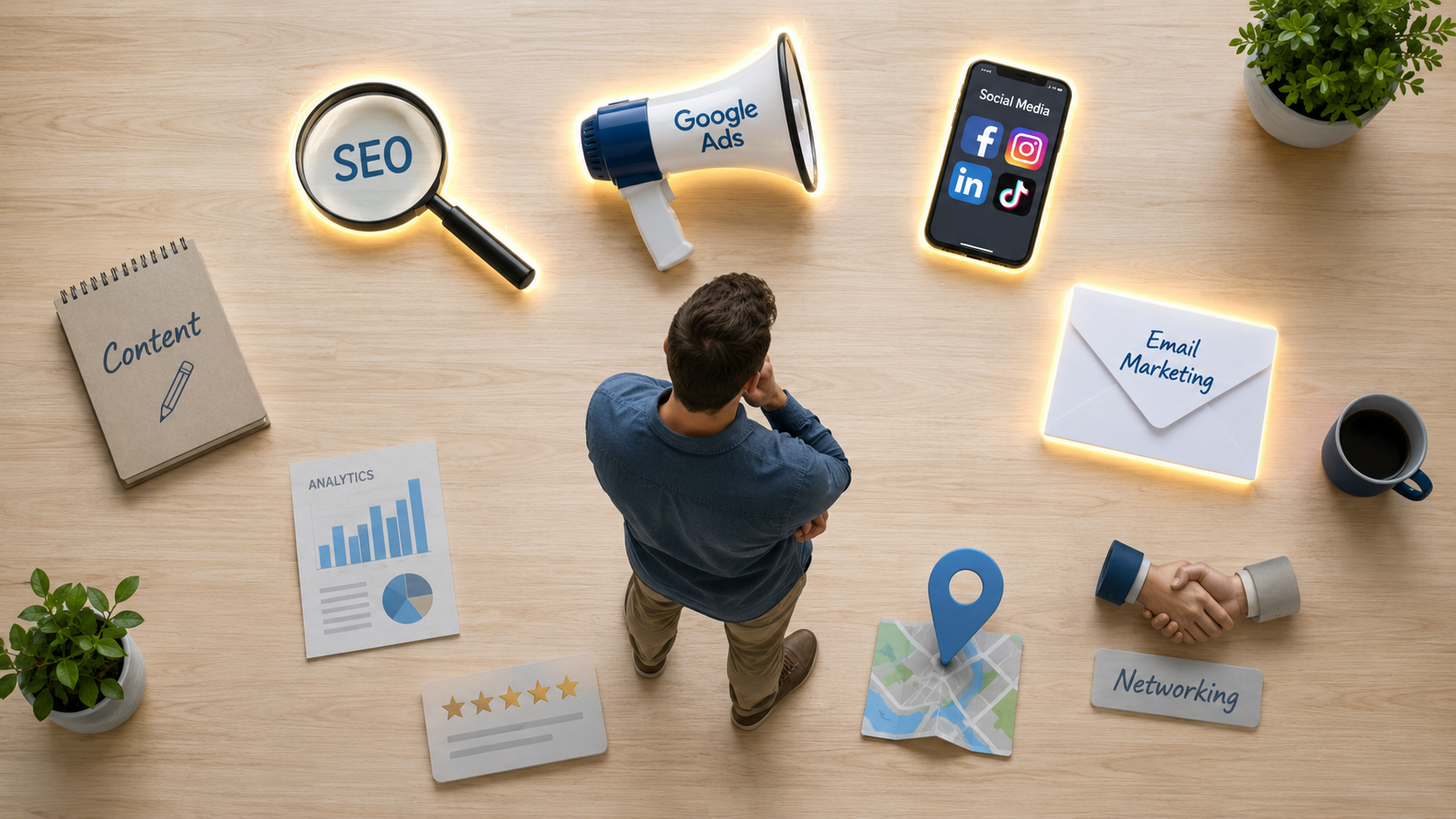
One of the most common questions business owners ask is:
What kind of marketing should I actually be doing?
Depending on who you ask, you may be told to invest in SEO, post on social media every day, run Google Ads, send email newsletters, attend networking events, start making videos, or join the newest platform everyone is talking about.
The problem is that no business has unlimited time, attention, or money.
A roofing contractor, restaurant, photographer, attorney, nonprofit, and online retailer should not all follow the same marketing plan.
The right strategy depends on how customers discover businesses like yours, how urgently they need what you offer, how long they take to make a decision, and what they need to see before they feel comfortable buying.
This guide breaks down which marketing channels usually make the most sense for different types of businesses, with practical advice for entrepreneurs throughout Orlando and Central Florida.
TL;DR
- Choose marketing channels based on how your customers actually make buying decisions.
- Local service businesses should usually prioritize Google, local SEO, reviews, and referrals.
- Restaurants, retailers, and creative businesses often benefit from visual social media and repeat-customer marketing.
- Professional services should focus on trust, expertise, educational content, and reputation.
- Paid advertising can create immediate visibility, while SEO builds longer-term value.
- Your website, customer database, and email list are assets you control. Social media accounts are not.
- Tracking calls, appointments, estimates, and sales is more useful than tracking followers alone.
- Doing a few marketing activities consistently is usually better than trying every available channel.
Start With Your Customer's Buying Process
Before choosing a platform or setting a marketing budget, ask one important question:
How does my ideal customer decide which business to hire?
Some customers search Google because they need help immediately.
Others ask friends, compare several companies, read reviews, watch videos, browse social media, attend events, or spend weeks researching before making a decision.
Your marketing should match that behavior.
For example, someone with a leaking roof is probably not scrolling Instagram hoping to discover a roofing company. That person is more likely to search Google for a roofer nearby, compare reviews, visit a few websites, and call the company that appears trustworthy and responsive.
Someone looking for a wedding photographer may behave differently. They may spend hours browsing portfolios on Instagram, Pinterest, and photographer websites before reaching out.
A business owner looking for an accountant may ask other professionals for a referral, review credentials, read articles, and schedule several consultations.
The strongest marketing plans begin with customer behavior, not marketing trends.
Understand the Four Stages of Customer Awareness
Customers may encounter your business at different stages of the buying process.
Awareness
The customer is becoming aware of a problem, need, product, or business.
Useful channels may include social media, local publications, community events, public relations, and educational content.
Research
The customer is learning about options and comparing possible solutions.
Useful channels may include SEO, detailed website pages, videos, case studies, reviews, and email content.
Decision
The customer is deciding which business to contact, visit, or purchase from.
Useful assets include clear pricing information, testimonials, strong service pages, professional branding, availability, and an easy contact process.
Retention
The customer has already purchased and may return, refer others, or buy additional services.
Useful channels include email marketing, loyalty programs, follow-up messages, referral programs, and consistent customer service.
A strong marketing strategy supports more than the first sale. It helps customers discover, evaluate, choose, return to, and recommend your business.
A Simple Marketing Decision Guide
| If customers usually... | Prioritize... |
|---|---|
| Need your service urgently | Google Business Profile, local SEO, Google Ads, reviews, fast phone response |
| Research before contacting you | Website content, SEO, reviews, case studies, email marketing |
| Choose based on appearance or style | Instagram, Pinterest, professional photography, portfolio website |
| Buy repeatedly | Email marketing, loyalty programs, social media, remarketing |
| Hire based on trust and expertise | Educational content, testimonials, professional website, LinkedIn |
| Rely heavily on local recommendations | Networking, referrals, community involvement, local features, directories |
| Have a long sales cycle | Email follow-up, case studies, educational resources, consultations, LinkedIn |
| Make impulse purchases | Visual social media, promotions, signage, events, retargeting |
Marketing for Home Service Businesses
Home service businesses include:
- Roofing companies
- Plumbers
- Electricians
- HVAC companies
- Painters
- Window and door contractors
- Landscapers
- Pressure-washing companies
- Handyman services
- Remodeling contractors
- Auto detailers
- Pest-control companies
Best Marketing Channels
- Google Business Profile
- Local SEO
- Google Ads
- Google reviews
- Referral programs
- Service-area pages
- Direct mail in carefully selected neighborhoods
Home service marketing is usually driven by intent.
A homeowner with a broken air conditioner, leaking pipe, damaged roof, or failing window is actively searching for help. Your goal is to appear when that search happens and quickly prove that your business is qualified, trustworthy, responsive, and available.
What to Focus On
- Create a separate website page for every major service.
- Create useful pages for the cities and communities you genuinely serve.
- Add real project photos rather than relying only on stock images.
- Ask satisfied customers for reviews after each completed job.
- Make your phone number and estimate form easy to find.
- Publish answers to common homeowner questions.
- Show licenses, insurance, certifications, and warranties when relevant.
- Track which calls and estimate requests become actual customers.
What to Avoid
- Sending all paid traffic to a generic homepage
- Creating dozens of nearly identical city pages
- Using fake project photos
- Ignoring missed calls
- Buying leads without tracking their quality
- Relying entirely on one lead-generation platform
For more guidance, read 7 Ways to Turn Your Website Into a Passive Lead Generator.
Marketing for Restaurants, Cafes, and Food Businesses
Best Marketing Channels
- Google Business Profile
- Google reviews
- Email marketing
- Local events and partnerships
- Loyalty programs
Restaurants are highly visual and highly local.
Potential customers want to see your food, understand your atmosphere, check your hours, read reviews, view your menu, and confirm whether you offer options that fit their needs.
What to Focus On
- Keep your menu, hours, phone number, address, and reservation information current.
- Post high-quality photos of real menu items.
- Highlight daily specials, seasonal offerings, and events.
- Respond professionally to customer reviews.
- Collect email addresses for promotions and announcements.
- Create pages for gluten-free, vegetarian, vegan, or allergy-conscious options when applicable.
- Partner with nearby businesses, community groups, and event organizers.
- Make online ordering or reservations easy to use on a phone.
What to Avoid
- Posting menu information only as an image
- Leaving outdated hours online
- Relying entirely on third-party delivery platforms
- Using food photos that do not represent actual dishes
- Ignoring negative reviews
Restaurants should avoid relying only on social media. Your website and Google Business Profile should remain reliable sources of accurate information.
Marketing for Professional Services
Professional services include:
- Attorneys
- Accountants
- Financial advisors
- Insurance agencies
- Business consultants
- Real estate professionals
- Technology consultants
- Engineers
- Architects
Best Marketing Channels
- SEO
- Educational content
- Professional website
- Email newsletter
- Reviews and testimonials
- Referral partnerships
- Speaking and professional associations
Professional service businesses are built on trust.
Potential clients often want to understand your experience, approach, qualifications, and ability to solve their specific problem before they contact you.
Educational content can be particularly valuable because it allows you to demonstrate expertise before a sales conversation ever begins.
What to Focus On
- Publish articles answering common client questions.
- Create detailed pages for each service or practice area.
- Include professional biographies and credentials.
- Use case studies where privacy and industry rules allow.
- Maintain a thoughtful LinkedIn presence.
- Build referral relationships with complementary professionals.
- Explain your consultation or onboarding process.
- Use clear language rather than unnecessary jargon.
What to Avoid
- Making guarantees you cannot support
- Publishing generic articles with no professional insight
- Using an outdated website that weakens credibility
- Ignoring professional advertising rules
- Hiding all useful information behind a consultation form
Start with What Is SEO and Why Should You Care? if you are still learning how organic search can support your business.
Marketing for Retail Stores and Boutiques
Best Marketing Channels
- Google Business Profile
- Email marketing
- Local events
- Loyalty programs
- Local SEO
- Text-message promotions when customers consent
Retail businesses often need to combine discovery with repeat engagement.
Social media can help people discover new products, while email marketing, text messages, and loyalty programs encourage customers to return.
What to Focus On
- Share new arrivals, seasonal collections, and promotions.
- Use professional product photography.
- Participate in local markets and community events.
- Collect customer emails at checkout with permission.
- Encourage customers to follow your social pages.
- Keep store hours and location information accurate online.
- Highlight locally made, exclusive, or limited products.
- Create reasons for customers to return.
If you sell online, make sure your product pages include clear descriptions, strong images, shipping details, return information, product availability, and customer reviews.
Marketing for Medical, Wellness, and Health-Related Businesses
Examples include:
- Chiropractors
- Dentists
- Physical therapists
- Massage therapists
- Counselors
- Wellness providers
- Holistic health businesses
- Fitness studios
Best Marketing Channels
- Local SEO
- Google Business Profile
- Patient or client reviews
- Educational content
- Email marketing
- Community outreach
- Referral relationships
People are cautious when choosing a provider connected to their health or well-being.
Your marketing should reduce uncertainty and help potential clients understand your services, approach, qualifications, limitations, and what to expect.
What to Focus On
- Clearly explain your services and appointment process.
- Answer common questions in plain language.
- Include provider biographies and credentials.
- Share testimonials only when permitted and appropriate.
- Make appointment scheduling easy.
- Build relationships with complementary local providers.
- Explain insurance, payment, and new-patient information clearly.
- Publish responsible educational content.
What to Avoid
- Unsupported medical claims
- Guaranteed outcomes
- Fear-based messaging
- Sharing private client details
- Using testimonials in ways that violate applicable rules
Clear, accurate, and responsible communication builds more trust than exaggerated promises.
Marketing for Creative Businesses
Creative businesses include:
- Photographers
- Videographers
- Artists
- Interior designers
- Graphic designers
- Event planners
- Florists
- Custom makers
Best Marketing Channels
- Portfolio website
- Google Business Profile
- Referrals
- Local partnerships
- Vendor directories
Creative services are often sold visually.
Customers want to see your style, quality, range, and previous work. Your portfolio is one of your most important marketing assets.
What to Focus On
- Showcase your strongest and most representative work.
- Organize your portfolio by service or project type.
- Explain the story or goal behind selected projects.
- Use testimonials from satisfied clients.
- Partner with complementary businesses.
- Create behind-the-scenes content showing your process.
- Explain packages, availability, and booking steps clearly.
- Use location information when your work serves a defined region.
A photographer may partner with wedding planners and venues. An interior designer may build relationships with builders, real estate agents, and home-service companies. These partnerships can create long-term referral channels.
Marketing for Coaches, Consultants, and Personal Brands
Best Marketing Channels
- Educational content
- Email newsletter
- LinkedIn or other relevant social platforms
- Speaking engagements
- Podcast appearances
- SEO
- Referral partnerships
- Workshops and webinars
For coaches and consultants, people are often buying your judgment, experience, method, communication style, and personality.
Your marketing should help potential clients understand how you think and what working with you is like.
What to Focus On
- Publish practical advice rather than only promotional content.
- Explain your process and ideal client.
- Share client outcomes without exaggeration.
- Build an email list.
- Appear on podcasts, webinars, and local events.
- Create a clear path to schedule a consultation.
- Develop a recognizable point of view.
- Use case studies or examples to clarify your approach.
What to Avoid
- Making unrealistic income or outcome promises
- Trying to appeal to everyone
- Publishing only motivational content without practical value
- Building your entire audience on one social platform
Marketing for Business-to-Business Companies
Best Marketing Channels
- Email outreach
- SEO
- Case studies
- Industry networking
- Referral partnerships
- Educational webinars
- Trade associations and conferences
Business-to-business purchases often involve more research, more decision-makers, and longer sales cycles.
Your marketing needs to prove that you understand the buyer's industry, challenges, risks, and goals.
What to Focus On
- Create service pages for specific industries or client types.
- Publish case studies with measurable outcomes.
- Use LinkedIn to build relationships rather than only broadcast promotions.
- Create useful guides and downloadable resources.
- Develop a consistent follow-up process.
- Make your value proposition specific and easy to understand.
- Address common purchasing objections.
- Create resources for multiple decision-makers.
What to Avoid
- Sending generic mass outreach
- Using vague claims such as “innovative solutions” without explanation
- Failing to follow up after initial interest
- Focusing only on features instead of business outcomes
Marketing for Nonprofits, Ministries, and Community Organizations
Best Marketing Channels
- Email newsletters
- Community partnerships
- Local events
- Storytelling content
- Google Business Profile when eligible
- Local media and business features
- Volunteer and donor outreach
Nonprofits, ministries, and community organizations usually depend on trust, relationships, participation, and clear communication.
The goal may not be a traditional sale. It may be attracting volunteers, informing families, increasing attendance, gathering donations, or connecting people with available services.
What to Focus On
- Clearly explain your mission.
- Show how people are being helped.
- Publish upcoming events and current schedules.
- Make donating, volunteering, or requesting help straightforward.
- Use real stories with proper permission.
- Keep contact details and leadership information current.
- Build partnerships with local businesses and organizations.
- Use email to maintain relationships with supporters.
What to Avoid
- Using vague mission language without practical details
- Failing to explain how donations are used
- Publishing outdated event information
- Making it difficult to volunteer or get involved
- Sharing personal stories without appropriate consent
SEO, Ads, Social Media, or Email?
Most businesses do not need to choose only one marketing channel.
Each channel serves a different purpose.
| Channel | Primary Purpose | Best For |
|---|---|---|
| Website | Educating, building trust, and converting visitors | Nearly every business |
| SEO | Building long-term search visibility | Businesses customers actively search for |
| Google Business Profile | Appearing in local search and Maps | Local and service-area businesses |
| Google Ads | Generating immediate search visibility | High-intent services and urgent needs |
| Social Media | Building awareness, familiarity, and engagement | Visual, community-driven, and lifestyle businesses |
| Email Marketing | Following up and increasing repeat engagement | Businesses with repeat, seasonal, or long-term customers |
| Networking | Building referrals and partnerships | Local services, professionals, nonprofits, and B2B companies |
| Local Features and Public Relations | Building credibility and introducing the business to new audiences | Entrepreneurs, community organizations, and distinctive local businesses |
| Direct Mail | Reaching specific neighborhoods or customer groups | Home services, local retail, events, and property-related businesses |
Paid Advertising Versus Long-Term Marketing
Paid advertising can generate traffic quickly, but the traffic usually stops when the budget stops.
SEO, educational content, reviews, email lists, community relationships, and referral networks take longer to build, but they can continue producing value over time.
A balanced strategy often uses both.
For example, a new contractor might run Google Ads to generate immediate leads while building service pages, collecting reviews, and improving local SEO for longer-term growth.
A restaurant might promote a grand opening through social media and local advertising while building an email list and reputation that supports repeat business.
A professional service company might use LinkedIn outreach for immediate conversations while publishing educational resources that strengthen credibility over time.
Do Not Build Your Entire Business on Social Media
Social media can be valuable, but it should not be your only marketing asset.
You do not control Facebook, Instagram, TikTok, LinkedIn, YouTube, or any other third-party platform.
Algorithms change. Accounts can be suspended. Reach can decline. Platforms can lose popularity.
Your website, customer database, email list, original content, and direct relationships are assets your business controls.
Use social media to introduce people to your business, then give them a reason to visit your website, join your email list, call you, attend an event, or become a customer.
Use Local Stories and Community Features
Local business features can support visibility, credibility, referral traffic, and community relationships.
A strong business feature gives readers more than a company name and website address. It explains who is behind the business, how it began, what challenges the owner has overcome, and why the work matters.
Local Legends Orlando was created to help Central Florida consumers discover businesses through authentic founder stories and professionally presented profiles.
Approved features may include business photographs, founder information, service details, social links, and a contextual backlink to the company's official website.
Submit your business for consideration.
Common Marketing Mistakes
Trying Every Platform at Once
It is better to execute two or three strategies consistently than to maintain ten neglected channels.
Posting Without a Purpose
Every post, article, video, or email should educate, build trust, demonstrate value, encourage engagement, or create a clear next step.
Ignoring Reviews
Reviews influence both visibility and customer confidence. Ask for them consistently and respond professionally.
Only Marketing When Business Is Slow
Marketing works best when it is maintained before you urgently need more customers.
Sending Traffic to a Weak Website
Advertising cannot permanently fix a confusing, outdated, or untrustworthy website. Your website should clearly explain what you offer and make it easy to contact you.
Tracking Vanity Metrics
Followers and website visits can be useful, but calls, appointments, estimate requests, email signups, donations, registrations, and sales are usually more meaningful.
Changing Strategies Too Quickly
Many channels require time, repetition, and refinement. Do not abandon a reasonable strategy after one week simply because it did not create immediate results.
Failing to Follow Up
Marketing creates opportunities, but poor follow-up wastes them. Respond promptly and maintain a clear process for leads, inquiries, and referrals.
Copying Competitors
Your competitors may be using the wrong strategy or targeting a different customer. Learn from them, but build your plan around your own audience and goals.
How Much Should a Small Business Spend on Marketing?
There is no universal percentage that fits every business.
The right budget depends on:
- Your revenue
- Profit margins
- Growth goals
- Industry competition
- Average customer value
- Sales cycle
- Current reputation
- Existing marketing assets
A newer business trying to grow quickly may invest a larger percentage of revenue than an established company with strong referrals and repeat customers.
Before increasing spending, understand:
- How much a qualified lead is worth
- How many leads become customers
- What an average customer spends
- How often customers return
- Which channels produce profitable business
The goal is not to spend as little as possible. It is to invest where the likely return justifies the cost.
How to Choose Your Primary Marketing Channels
Use these five questions to narrow your choices:
- Where do customers look when they need this product or service?
- How urgently do they need it?
- What proof do they need before making a decision?
- How often are they likely to buy again?
- Which channels can the business maintain consistently?
Choose:
- One primary discovery channel
- One trust-building channel
- One follow-up or retention channel
Example for a Roofing Company
- Discovery: Google search and Google Business Profile
- Trust: Reviews, project photos, and service pages
- Follow-up: Email or text estimate follow-up
Example for a Boutique
- Discovery: Instagram and local events
- Trust: Product photos and customer reviews
- Retention: Email list and loyalty program
Example for a Consultant
- Discovery: LinkedIn, referrals, and SEO
- Trust: Educational content and case studies
- Follow-up: Email newsletter and consultations
Where Should a Small Business Start?
If you are overwhelmed, begin with a simple foundation.
- Create or improve your professional website.
- Complete your Google Business Profile when eligible.
- Ask satisfied customers for genuine reviews.
- Choose one primary marketing channel based on customer behavior.
- Publish helpful content consistently.
- Collect customer email addresses when appropriate and permitted.
- Create a dependable lead follow-up process.
- Track where inquiries and customers come from.
You can expand once these fundamentals are working consistently.
A Practical 90-Day Marketing Plan
Month One: Build the Foundation
- Review your website.
- Complete your Google Business Profile.
- Correct outdated contact information.
- Identify your three most important services.
- Set up basic lead tracking.
Month Two: Build Trust
- Request reviews from recent satisfied customers.
- Add real photographs.
- Publish one case study or business story.
- Create or improve your About page.
- Clarify your calls to action.
Month Three: Expand Visibility
- Publish one helpful article.
- Reach out to a community partner.
- Submit your business to relevant directories.
- Test one paid or organic promotional campaign.
- Review which efforts produced inquiries.
How to Know Whether Your Marketing Is Working
Track outcomes connected to the purpose of your business.
Useful Metrics
- Phone calls
- Contact-form submissions
- Estimate requests
- Appointments
- Reservations
- Purchases
- Email signups
- Repeat customers
- Donations
- Volunteer applications
- Qualified leads
- Revenue by source
Ask new customers how they found you. Analytics tools are useful, but direct customer answers can reveal referrals, community mentions, AI recommendations, and offline marketing that software may miss.
Helpful Resources for Central Florida Entrepreneurs
- SCORE Orlando provides mentoring and educational resources for entrepreneurs.
- Orlando Economic Partnership supports businesses and economic development throughout the Orlando region.
- Seminole County Chamber offers local networking and business-development opportunities.
- U.S. Small Business Administration provides planning, funding, and management resources.
- What Is SEO and Why Should You Care?
- 5 Things You Can Do Today to Rank Higher on Google
- Build Domain Authority with Business Directories
- How to Get Free Backlinks That Actually Help Your SEO
Need Help Choosing the Right Marketing Strategy?
Every business has different customers, competition, goals, resources, and growth challenges. A marketing strategy should reflect those differences.
At BastionTech, we help contractors and local service businesses improve the digital foundation behind their marketing through custom websites, local SEO, Google Business Profile optimization, technical improvements, and conversion-focused strategy.
Rather than chasing every new platform, the goal is to identify the channels most likely to produce qualified leads and build assets that continue supporting the business over time.
Helpful BastionTech Services
- Custom Contractor Websites
- Local Contractor SEO in Central Florida
- Google Business Profile Optimization
- Oviedo Web Design
- Website Project Scope and Pricing
- Request a Free Website Review
Frequently Asked Questions
Should Every Business Use Social Media?
Most businesses benefit from maintaining at least a basic social presence, but the amount of effort invested should depend on whether customers actively use those platforms to discover or evaluate businesses like yours.
Is SEO Better Than Google Ads?
They serve different purposes. Google Ads can create immediate visibility, while SEO builds longer-term organic visibility. Many businesses benefit from using paid advertising while developing their SEO foundation.
How Much Should a Small Business Spend on Marketing?
The right amount depends on growth goals, margins, competition, customer value, and the business's current stage. Begin with a sustainable budget and track which activities produce qualified leads and profitable customers.
Which Marketing Channel Should I Start With?
Start with the channel customers are most likely to use when looking for a business like yours. For many local service companies, that means Google Business Profile, reviews, and local SEO.
How Long Should I Test a Marketing Strategy?
That depends on the channel. Paid advertising can often produce useful data relatively quickly, while SEO, content, email lists, and referral partnerships require more time. Set a reasonable test period and define success before beginning.
Do I Need to Post on Social Media Every Day?
No. A consistent schedule of useful, relevant content is generally better than daily posts created only to remain active.
Should I Hire Someone or Handle Marketing Myself?
Business owners can often manage foundational activities such as requesting reviews, publishing updates, networking, and maintaining accurate information. Technical, time-intensive, or highly competitive work may justify professional help.
How Do I Know Whether My Marketing Is Working?
Track calls, contact forms, appointments, estimate requests, sales, donations, registrations, repeat customers, and referrals. Ask new customers how they found you and use analytics tools to support those answers.
Should I Use AI for Marketing?
AI can support research, planning, drafting, organization, and follow-up. It should not replace accurate information, original experience, responsible review, or genuine customer relationships.
Continue Growing Your Business
Use these guides to strengthen your online visibility, website performance, authority, and broader marketing strategy.
- What Is SEO and Why Should You Care?
- 5 Things You Can Do Today to Rank Higher on Google
- How to Get Free Backlinks That Actually Help Your SEO
- Build Domain Authority with Business Directories
- 7 Ways to Turn Your Website Into a Passive Lead Generator
- How to Get AI to Recommend Your Business
Discover Central Florida Business Stories
Local Legends Orlando shares the stories behind entrepreneurs, organizations, ministries, and family-owned businesses serving communities throughout Central Florida.
- BastionTech LLC: A Local Legends Story
- Zeigers Auto Detailing: A Local Legends Story
- Redefining With Jesus: A Local Legends Story
Final Thoughts
The best marketing strategy is not necessarily the newest, loudest, or most complicated one.
It is the strategy that consistently connects your business with the right people at the right point in their buying process.
Start by understanding how your customers make decisions. Build a strong website, improve your local visibility, earn trust, and choose a few marketing channels you can maintain well.
Consistency, measurement, and good customer service usually create better long-term results than constantly chasing the next marketing trend.